Resolving Quantum Paradoxes with Vedic Aakash
For over a century, physics has stood on an unusual foundation. It is extraordinarily successful in predicting experimental outcomes, yet deeply uncomfortable when it comes to explaining what is actually happening in reality. The pioneers of quantum mechanics themselves openly admitted this unease. Richard Feynman famously remarked that no one truly understands quantum mechanics, and Niels Bohr warned that anyone who thinks they understand it has not grasped its strangeness. At the heart of this discomfort lies a simple but profound issue: modern physics works mathematically, but it lacks an intuitive, mechanical picture of nature.
The most striking example of this problem is the Double-Slit Experiment. When tiny particles such as photons or electrons are fired through two narrow slits, they produce an interference pattern on a screen—something we normally associate with waves, not particles. Yet when we attempt to observe which slit the particle passes through, the pattern disappears, and the particles behave like solid objects again. This has led to the now-famous idea of wave–particle duality and the even more puzzling claim that observation itself somehow alters reality. In many explanations, this begins to sound almost mystical, as if nature is aware of being watched.
But what if the problem is not with nature, but with our assumptions?
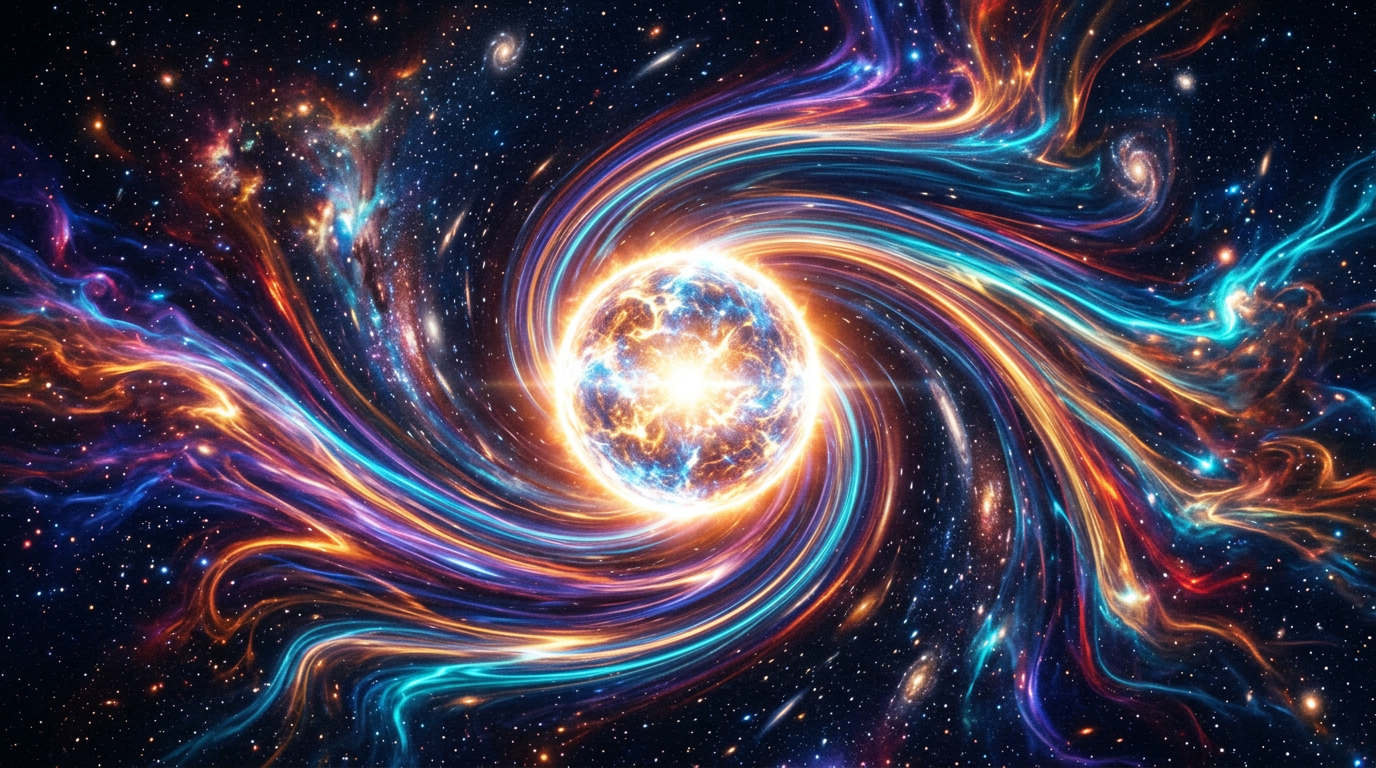
The paper proposes a simple but radical shift: space is not empty. Instead, it is filled with a continuous medium called Aakash—conceptually similar to an “ocean of photons.” This idea is not entirely new. Ancient Vedic philosophy described Aakash as the fundamental substrate of reality, and early physicists once proposed an “ether” filling space. That concept was abandoned after the Michelson–Morley experiment failed to detect a stationary medium. However, this rejection may have been premature. The experiment ruled out only a rigid, static ether—not a dynamic, flowing, interactive medium.
If space is indeed filled with such a medium, the Double-Slit Experiment becomes far easier to understand. Consider a simple analogy. If you throw water droplets through two slits in air, they form two distinct bands on a screen—clearly particle-like behavior. But if you perform the same experiment inside a tank of water, each droplet creates ripples in the surrounding fluid. These ripples spread out, pass through both slits, and interfere with each other, producing a wave pattern. The difference is not in the droplets themselves, but in the presence of a medium.
Applying this idea to light, a photon does not need to split or exist in two places at once. Instead, it disturbs the surrounding Aakash, generating a wave that travels through both slits and interferes on the other side. The photon remains a single entity; the wave is simply the response of the medium. This removes the need for abstract concepts like wave–particle duality or mysterious wave function collapse. The behavior becomes mechanical and intuitive.
The disappearance of the interference pattern during observation also finds a straightforward explanation. Detectors placed near the slits are not passive observers—they physically interact with the system. They disturb the medium, effectively narrowing the slits and introducing turbulence. This disruption prevents the smooth formation of waves, resulting in particle-like patterns. There is no need to invoke consciousness or observer-induced reality; the effect arises from ordinary physical disturbance.
This perspective extends beyond light. The paper argues that all matter is fundamentally a form of vibration within Aakash. An electron can be seen as a stable, localized wave pattern, while larger objects are more complex, densely packed vibrations. Even macroscopic objects like a baseball have a wave nature, though it is too small to detect under ordinary conditions. In this view, the universe is not made of isolated particles moving through empty space, but of continuous waves interacting within a single medium.
Mass and inertia take on a far more intuitive meaning in this framework. In modern physics, the Higgs field is said to “give” mass to particles, but this raises a basic question: mass is an intrinsic property of matter—why should it need to be acquired from something external? A clearer picture emerges when we distinguish mass from inertia. Mass belongs to the object itself, whereas inertia—the resistance to motion—is what we actually observe, and this depends not only on the object but also on the medium it moves through. Just as it is harder to move an object through water than through air, resistance arises from interaction with the surrounding environment.
From this perspective, inertia is not purely intrinsic but emerges from the interaction between mass and a universal background medium. If space were truly empty, there would be no resistance at all, and even the slightest force would accelerate objects indefinitely—something we do not observe in nature. This implies that space must be filled with a subtle medium. What is called the Higgs field can then be reinterpreted not as something that creates mass, but as the manifestation of this all-pervading medium—Aakash, the cosmic photon ocean. In this view, mass is intrinsic, while inertia arises as a friction-like resistance due to motion through Aakash, providing a simple, mechanical explanation that unifies Higgs, ether, and dark matter into a single physical reality
Gravity, perhaps the most mysterious force of all, is reimagined in similarly intuitive terms. Rather than being the result of curved spacetime, it is described as a fluid dynamic effect. Massive bodies create vortices in the Aakash medium, much like whirlpools in water. These vortices generate pressure differences, causing surrounding matter to be pushed inward. What we perceive as gravitational attraction is, in this model, the result of fluid flow and pressure gradients.
Even the concept of dark matter finds a natural place here. Instead of invoking unknown, invisible particles, the missing mass required to explain galactic motion is attributed to the mass and dynamics of the Aakash medium itself. The need for entirely new entities disappears; the medium already present accounts for the observations. Importantly, the paper does not stop at conceptual explanations. It attempts to formalize this framework mathematically by treating Aakash as a fluid governed by equations similar to the Navier–Stokes equations used in fluid dynamics. This provides a bridge between abstract theoretical physics and well-understood mechanical principles.
https://www.isca.me/rjrs/archive/v15/i1/5.ISCA-RJRS-2025-023.pdf
Perhaps the most intriguing aspect of the work is its connection to human perception and consciousness. If reality is fundamentally wave-like, then our everyday experience of solid, discrete objects may be a limited perception. The paper draws a parallel between experimental sensitivity in physics and perceptual sensitivity in practices like meditation and yoga. Just as refining an experiment reveals wave behavior, refining perception may reveal a deeper, interconnected reality.
In essence, the paper argues that many of the paradoxes of modern physics arise from a single assumption—that space is empty. By restoring a real, physical medium, these paradoxes dissolve into straightforward mechanical processes. Interference becomes wave interaction, collapse becomes disturbance, gravity becomes fluid motion, and mass becomes resistance within a medium. The proposal is bold and challenges deeply entrenched ideas. But its appeal lies in its simplicity. It replaces abstraction with intuition, mystery with mechanism, and fragmentation with unity. Whether ultimately proven correct or not, it invites us to reconsider a fundamental question: what if the universe is not a collection of isolated particles in empty space, but a continuous ocean where everything is connected through motion, vibration, and flow? And if that is the case, then the strange behavior we call “quantum mechanics” may not be strange at all—it may simply be the natural behavior of waves in a medium we have long overlooked.