
Beyond Aerospace and Weather: How DMR Could Transform Artificial Hearts
One of the most exciting potential applications of the Directional Momentum Redistribution (DMR) framework lies in cardiovascular engineering — specifically in the design of Ventricular Assist Devices (VADs) and Total Artificial Hearts (TAHs).
These life-saving devices currently face a devastating problem: they often damage blood itself.
The Deadly “Blender Effect”
Traditional artificial hearts use rapidly spinning impellers to pump blood. While mechanically efficient, they create highly chaotic, turbulent flow:
- Blood cells are subjected to intense, multi-directional shear stress.
- Red blood cells (erythrocytes) rupture — a process called hemolysis.
- Platelets are activated by the chaos, leading to dangerous blood clots (thrombosis).
Patients with these devices often require powerful blood thinners for life, which carry their own serious risks like internal bleeding.
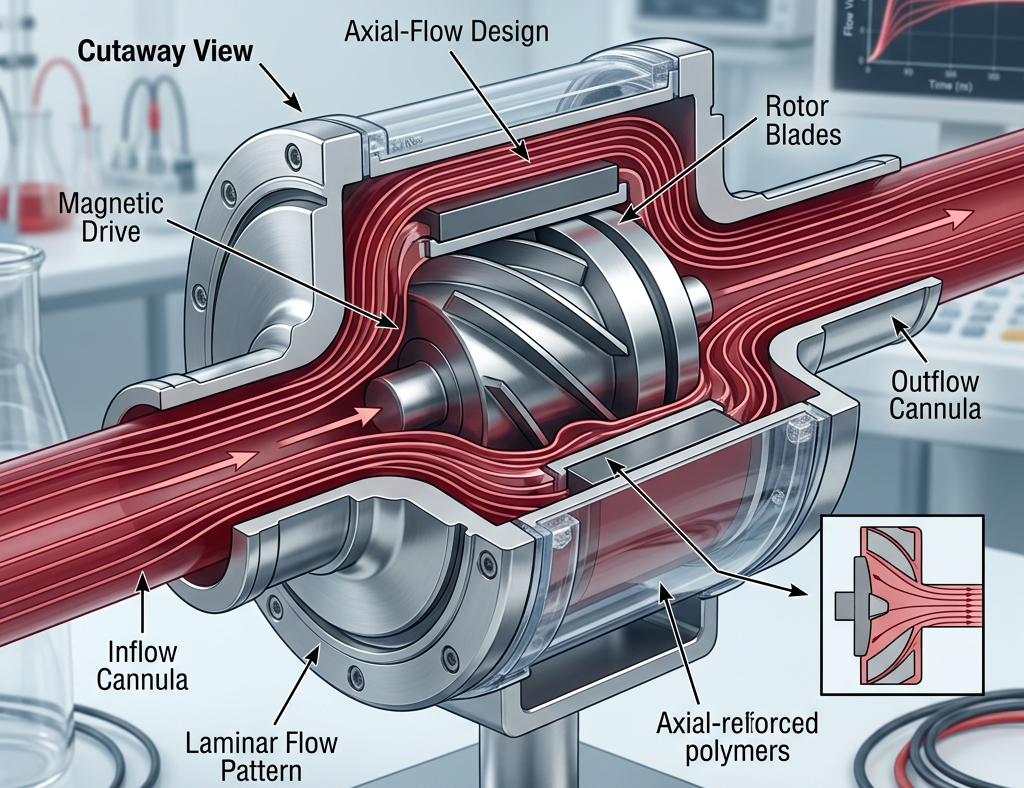
The DMR Solution: “Smart” Blood Flow
The DMR framework introduces an “alignment meter” (the anisotropy field a) that allows the blood flow to self-organize intelligently:
Step 1: Strain Sensing The model continuously detects regions of high strain (where blood is being violently stretched or sheared). In these zones, the anisotropy value a automatically increases.
Step 2: Directional Alignment Instead of allowing chaotic tumbling, the flow is gently encouraged to align momentum along the main direction of pumping. This reduces destructive sideways forces on blood cells.
Step 3: Adaptive, Localized Dissipation Using the strain–anisotropy feedback loop, DMR applies extra damping exactly where it is needed — smoothing out dangerous micro-vortices before they can damage cells.
Step 4: The Quartic Safety Governor The quartic control term () acts as an automatic stabilizer. If shear stress begins to approach dangerous levels, the mechanism strongly suppresses extreme stretching, preventing the flow from ever reaching the breaking point of red blood cell membranes.
Potential Clinical Benefits
- Reduced Hemolysis — Fewer ruptured red blood cells.
- Lower Thrombosis Risk — Less platelet activation due to reduced chaotic flow.
- Decreased Need for Blood Thinners — Potentially safer long-term therapy.
- Improved Device Longevity — Less turbulent energy waste means reduced mechanical wear.
- More Natural Flow — The pump behaves more like a biological vessel with organized, directional flow rather than a mechanical blender.
From Theory to Life-Saving Technology
The DMR approach treats blood not as a simple Newtonian fluid, but as a living transport system that responds to directional cues. By embedding this intelligence into the control software or even the physical geometry of next-generation artificial hearts, we could move from “brute force pumping” to biomimetic, adaptive flow management.
This is still a theoretical extension — careful computational fluid dynamics (CFD) studies and eventual experimental validation will be needed. But the underlying physics is promising: organized flow hurts blood less than chaotic flow.
The same principle that helps control turbulence in aircraft or weather models may one day help keep real human blood safer inside mechanical hearts.


