Tag Archives: ether

Gravity and Bernoulli principle

Physicists are good at observing things and connecting them by some weird mathematics despite not knowing what actually happens beneath the ‘visible’ layer of things. And it is their eccentric mathematical intelligence which has made them reasonably successful both in predicting the Nature and in designing various gadgets of our modern society despite their totally false picture of the invisible world and their subnormal thinking about the universe as a whole.

Scientists utilise Bernoulli principle to ‘lift’ aircrafts against the Earth’s gravity but I am sure they don’t really understand how this principle works. If they had, they would have realised long ago that it is the same principle that underlies the mystery of gravity. And Bernoulli principle would have become much more famous than Newton’s laws and wouldn’t have let Einstein’s theories distort our understanding of Gravity.

Bernoulli principle as understood by physicists states that ‘the pressure exerted by a fluid decreases as its velocity increases’. In other words, as a fluid moves faster, it exerts less pressure. Some physicists think that it is the law of conservation of energy that underlies the Bernoulli principle; while others attribute it to Newton’s 2nd law. Some argue that both the above laws just represent different facets of the same fundamental phenomenon and hence believe that either can be made use of to explain Bernoulli Effect. That just highlights their ignorance on not just Bernoulli Effect but also on the laws which they try to make use of to explain Bernoulli Effect. The fact is that we need neither of them to understand how Bernoulli principle works. What we need is just common sense.

To correctly explain Bernoulli’s effect we must first correctly understand about pressure. Pressure is defined as force per unit area. We know that force is a vector which means that a force is not just a quantity but also has a direction. For example if someone says ‘‘a force of 1Newton is applied on the ball’’, it conveys little meaning because we need to mention in what direction that said force is applied to make sense. There could a number of forces acting simultaneously on a body from many directions, but the sum total of all the forces is what decides the final force vector and hence the direction of work. Because pressure is nothing but force, it implies that pressure is also a vector. So whenever we talk about pressure, it makes again no sense if we just say 1 Pascal or 2 Pascals and not mention the direction of pressure. This fact is often ignored or forgotten when physicists talk about pressure. Pressure i.e. the force exerted by a body, can be different in different directions. For example a book lying on a table may exert a downward pressure of 1pascal but it exerts no pressure in the upward direction or laterally. And we all know that the pressure exerted by water inside a container on the earth is not same in all directions.

Having realised that pressure is a vector; now we will go on to understand what pressure means at a deeper level. We know that a gas or a liquid exerts pressure on the walls of its container. But what is the fundamental mechanism that underlies the phenomenon of pressure? In other words from where does that force which we feel as pressure come? For this we will have to go to the kinetic theory of gases which states that the pressure of a gas is caused by collisions of its molecules against the walls of the container. The sum of the impacts per unit area of a wall is what we measure as the pressure applied upon that wall or in that direction.

We ‘know’ that the molecules or the atoms of a gas are in a state of random motion and collide with each other and with the walls of the container. Random motion implies that the molecules of a gas move equally in all directions (or in other words there is no net movement) and hence collide equally with all the walls and exert equal pressure in all directions. This is probably the reason why physicists ignore direction when they talk about pressure.

It is may be true that a gas inside a balloon exerts equal pressure in all directions in some situations, for example in the outer space and away from the celestial bodies when there is no ‘external influence’ upon the gas particles. But in the vicinity of earth, the effect of gravity can make the molecules move faster toward the bottom wall of a container and hence we may expect a little more pressure exerted upon that wall. (More over the term ‘random motion’ is only true at a gross level. If we magnify things and look deeply into the microcosm we would probably appreciate a highly ordered motion of the molecules and will be able to appreciate the slight differences in pressure in different directions)

In summary,

1) Pressure is nothing but force exerted per unit area of a surface

2) Pressure is a vector quantity

3) It is collisions of particles against a surface which manifests as pressure upon that surface.

Now imagine a container ‘filled’ with some gas. The gas molecules or particles move randomly and collide with the walls of the container. As discussed earlier, the sum of the impacts per unit area of a wall is what we measure as pressure upon that wall. If we ignore gravity and other external influences, the gas molecules collide equally against all the walls and hence exert equal pressure in all the directions i.e. on all the walls of the container. Now let’s remove the left and right walls of the container and make the gas to flow through the box in the rightward direction. Obviously the gas particles no longer move ‘randomly’ in all directions but move ‘preferentially’ towards the right. So the number of collisions against the top, bottom and other remaining walls of the container diminish. The result is that we measure less pressure being exerted by the gas on these remaining walls of the container. And the faster a gas flows in a given direction, the lesser the number of collisions on the side walls and the lesser the sideward pressure.

The statement that a fast moving fluid exerts less pressure makes no sense. The truth is that it exerts less pressure only on the side walls (i.e. in the perpendicular direction). If we place a pressure gauge just opposite to the flow of gas, we will realise that it actually exerts much higher pressure in the direction of flow. (And obviously much lower pressure in the opposite direction)

Now imagine a body suspended in a tank of still water. Obviously the water particles keep colliding with the body on all its sides with equal force. In other words the water exerts equal pressure on all the sides on the body. And because there is no net force acting upon it, the body remains still and suspended inside the water.

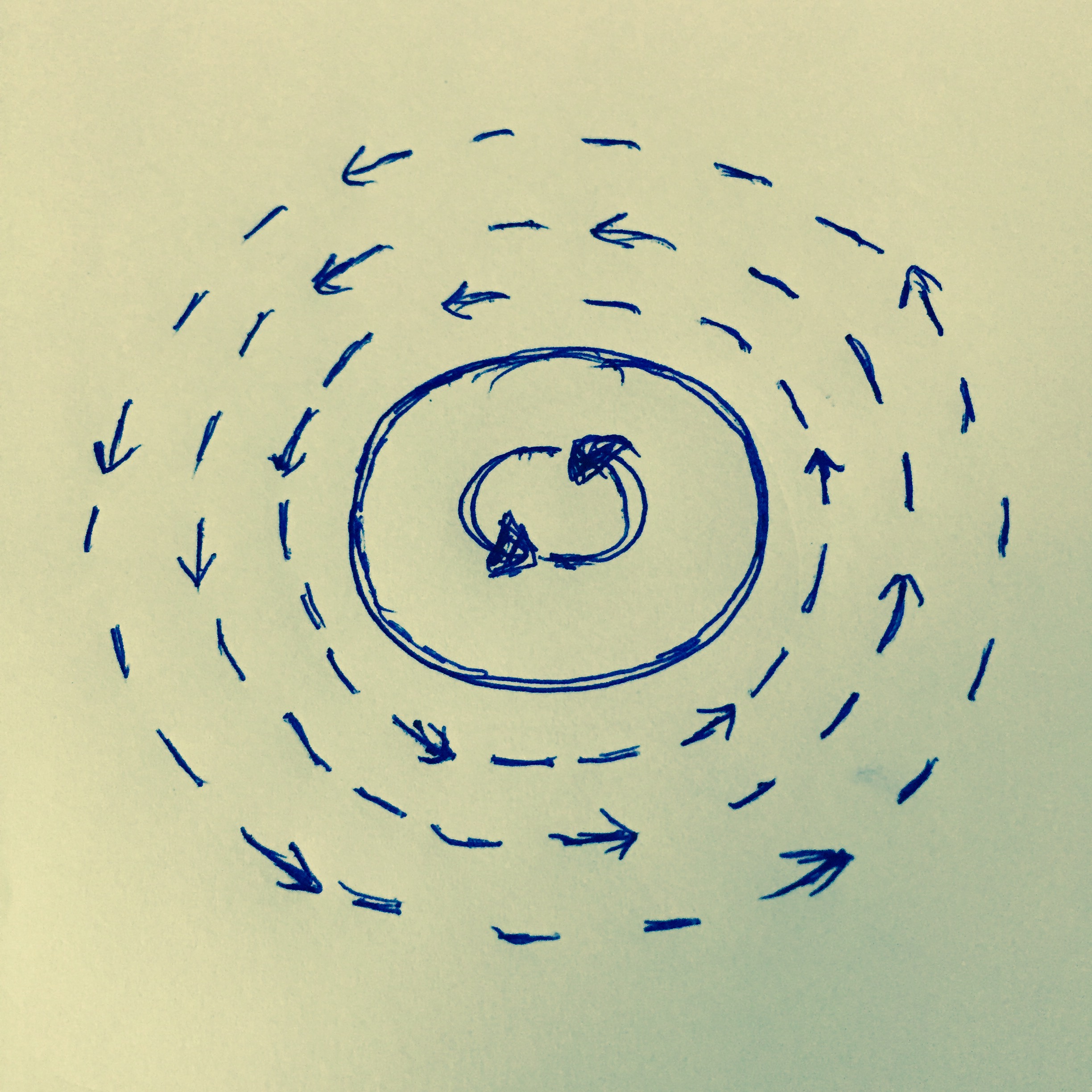
Now imagine that there exists another body in the vicinity and which starts spinning vigorously. The body obviously stirs the water around it and induces circular currents in the water tank. Obviously the water particles that are closer to the spinning body get stirred faster than the ones that are farther away.

How would this scenario influence the first body?

  1. the body which was still before starts moving in the direction of the water currents
  2. it starts spinning (in the opposite direction to that of the ‘inducer’)
  3. and it gets dragged towards the second body

Now replace water tank with Ether universe. Imagine a body suspended in still Ether. Imagine Earth nearby and allow it to spin. That explains gravity.

But from where does this spin come?

Ether or Cosmic Microwave Background Radiation (CMBR)

While explaining the wave like behaviour of photons in the double slit experiment, I have resurrected the concept of Ether. And I have proposed that Ether is nothing but a sea of photons permeating our entire universe. (http://debunkingrelativity.com/2013/12/08/explaining-the-double-slit-experiment/)

But if our universe is filled with photons and if we are living in a sea of photons, then why don’t we feel the same? Here is the explanation.

We know that we live in an environment filled with air which is nothing but a mixture of various gas molecules or ‘particles’. We can only feel these air particles around us only when there is movement of them. If the weather is absolutely still and there are no winds at all, we obviously don’t feel the air around us. That means for us to sense the presence of air around us, the particles of air must impinge upon our body with some force and our skin must be sensitive enough to sense these impacts.

But we know that even in the quietest of the quiet weathers (i.e. even when we think that the air is absolutely still without any winds), there will be some amount of random motion of the air particles and so they probably keep colliding with our skin albeit with a tiny force. But our skin is not usually sensitive enough to sense these weaker impacts coming from the randomly moving air particles. So we are not usually aware of the presence of air around us in still weather. (Or may be that, our sensory neural network has ‘learned’ to ignore these weak background impacts that we receive incessantly from the environment).

But imagine that we have a sensitive instrument that detects these weak collisions (i.e. those collisions resulting from the random motion of the air molecules in the absence of any net air movement or winds). The instrument obviously records a uniform and diffuse pattern of impacts because every inch of its surface receives an equal number of collisions. And the pattern and strength of impacts will remain the same in every direction the instrument ‘looks’.

Same thing is with our Ether which is nothing but a sea of photons. The mere presence of an object in our vicinity doesn’t mean that we will be able to feel the object. For us to feel and be aware of that object, there must be enough interaction between our sense organs and the object. Similarly, though we live in an environment filled with photons, unless there are Ether winds and unless the photons collide with our photosensitive retina with strong enough force, our eyes can’t see or feel the existence of Ether. And when we don’t receive strong collisions from the Ether particles, we don’t appreciate any light, in other words we see only darkness or ‘blackness’. So darkness is something that we feel when our photosensitive organs don’t receive any collisions from the sea of photons.

But even in the darkest of the dark spaces, there is possibly going to be some random motion of Ether particles similar to the random motion of air particles in the quietest of the quiet weathers. And similar to the detector that we have used above to sense the random motion of air particles, imagine that we have a sensitive detector that can sense and record the weak impacts due to the random motion of Ether particles. Obviously the detector would record the same uniform pattern of signals or impacts in every direction.

Do we have any experimental proof of this kind of random motion of Ether particles and which is same in every direction we look?

Yes. But our modern physicists, as is usually the case, have misinterpreted, misunderstood and mislabelled that as ‘Cosmic Microwave Background Radiation’ (CMBR). And as usual they have a weird explanation for that observation.

http://en.wikipedia.org/wiki/Cosmic_microwave_background_radiation


Go to Next Page

Go to Main Index