
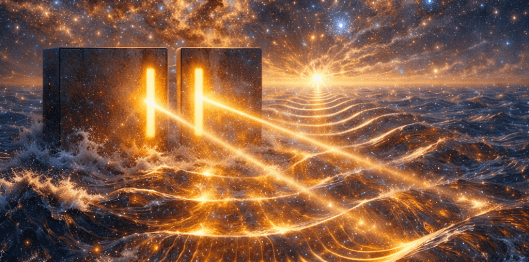
Modern physics, despite its remarkable predictive successes, grapples with profound paradoxes that have left even its pioneers bewildered. Figures like Richard Feynman and Niels Bohr openly admitted the field’s inherent lack of intuitive coherence, with Feynman remarking that, “No one understands quantum mechanics” and Bohr warning that true comprehension induces vertigo. At the heart of this turmoil lies the Double-Slit Experiment (DSE), which birthed enigmatic concepts such as wave-particle duality and the observer effect—ideas that seem to infuse mysticism into empirical science. This paper proposes a resolution by resurrecting the Vedic notion of Aakash (Ether) as a singular, tangible, continuous medium: the “Ocean of Photons.” Through this lens, the DSE’s infamous “wave function collapse” emerges not as a probabilistic enigma dependent on consciousness, but as a straightforward mechanical perturbation induced by the detector’s physical intrusion. This framework unifies disparate elements like the Higgs Field, Dark Matter, and gravity, forging a bridge between the ancient Pancha Bhutas (five elements) and contemporary physics. Moreover, it extends the DSE’s wave-particle toggle to Yogic methodologies, illuminating a rational, evidence-based route to perceiving omnipresence and achieving spiritual enlightenment. By demystifying quantum paradoxes and restoring mechanical causality, this model invites a paradigm shift toward a cohesive, logic-driven understanding of reality. With assistance from Grok (xAI), a novel Lagrangian formalizes Aakash as a viscous, incompressible fluid, yielding Navier-Stokes equations that mechanize its hydrodynamic behaviors.
From QM vertigo to Vedic hydrodynamics, it’s here.


